
Healthcare Solutions

Home » Healthcare Solutions

Protect Patients, Protect Lives: Fire and Life Safety Solutions for Healthcare

In healthcare facilities, life safety systems are a critical line of defense, not just a maintenance requirement. Most facilities manage fire alarm, sprinkler, security, and nurse call systems through separate vendors, creating coordination gaps and documentation risk. Midwest Alarm Services (MWAS) brings design, installation, inspection, and monitoring under one partner, so your team spends less time managing vendors and more time on patient care.

One Partner for Your Full Life Safety Program

MWAS is recognized as the NOTIFIER Engineered Systems Distributor of the Year, with an expansive network of regional branches across the Midwest and more than 100 NICET-certified life safety technicians. Our dedicated healthcare team works from Building Reports healthcare software to deliver Life Safety Compliance Books, a complete annual documentation record organized around TJC, CMS, and AHJ requirements, updated quarterly with training and support for Joint Commission surveys.

We Can Inspect Any Fire Alarm System

Fire alarm systems require semi-annual or annual inspection. Specific components follow their own testing intervals:

  • Smoke and duct detector sensitivity testing (Tru-Test or panel printout): every 2 years (NFPA 72-2010; 14.4.5)
  • VESDA (air-sampling smoke detection) systems: annually (NFPA 72-2010)
  • Elevators equipped with fire fighter service (elevator recall): monthly (NFPA 101-2012; 9.4.6.2)

Fire sprinkler systems, including wet, dry, pre-action, deluge, anti-freeze loop, standpipe, foam, Protectowire, fire pump, and backflow (domestic and fireline) systems, are inspected on a schedule ranging from monthly to every 5 years, per NFPA 25-2011:

  • Control valves, alarm valves, check valves, PA valves, deluge valves, and PIVs: monthly (13.3.2.1.1)
  • Gauges: monthly (13.2.7.1)
  • Fire pump churn test: weekly for diesel pumps, monthly for electric pumps (8.3.1)
  • 2½″ hose connection valve test: annually (13.5.6.2.1)
  • 1½″ hose connection valve test: every 3 years (13.5.6.2.2)
  • Pre-action system air-leakage test: every 3 years; dry pipe full trip test every 3 years, partial trip annually (13.4.3.2.6 / 13.4.4.2.2.2)
  • 5-year internal pipe inspection, including check valves and full gauge replacement: every 5 years (14.2.1)
  • Private fire hydrants, functional test: annually (7.3.2)
  • Private fire hydrants, full inspection: every 5 years (7.3.1)
  • Standpipe flow test: every 5 years (6.3.1)

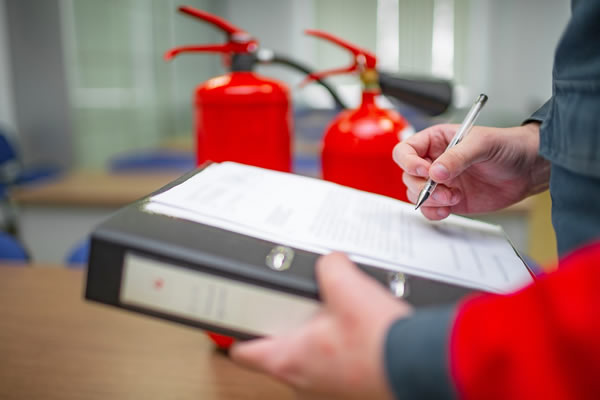
Per NFPA 10-2010, portable fire extinguishers require a monthly visual inspection (7.2.1.2) and a more thorough annual inspection (7.3.1.1.1).

Per NFPA 101-2012, emergency lighting and exit signs required for egress need a monthly functional test with a 30-second battery-backup check (7.9.3.1.1(1)) and an annual functional test that includes a 90- minute burn test (7.9.3.1.1(3)). Fixtures without battery backup require a monthly visual inspection instead of the functional test.

Fire dampers, smoke dampers, and combination fire/smoke dampers follow different testing requirements based on how each is activated:

  • Fire dampers close using a fusible link that melts at a set temperature and are typically not connected to the fire alarm system. They are tested 1 year after installation, then every 4 years thereafter, or every 6 years in hospitals (NFPA 80-2010, Section 19.4.1 / 19.4.1.1).
  • Smoke dampers and fire/smoke dampers are motorized and activated by a duct smoke detector tied into the fire alarm system. The damper itself follows the same 1-year, then 4-year (6-year in hospitals) test cycle (NFPA 105-2010).
  • The duct smoke detector that activates a smoke or fire/smoke damper is tested separately and annually, as part of the fire alarm system (NFPA 72-2010).

Fire doors require an annual test covering 13 inspection points, per NFPA 101-2012 (7.2.1.15.2) and NFPA 80-2010 (5.2.1).

Alternative suppression systems each follow their own NFPA-specified schedule:

  • Kitchen hood systems: monthly inspection (NFPA 17A-2009; 7.2.1), semi-annual test (17A-2009; 7.3.3)
  • CO2 systems: monthly inspection (NFPA 12-2011; 4.8.1), semi-annual tank weigh (12-2011; 4.8.3.5.1), annual test (12-2011; 4.8.3.2)
  • Clean agent systems: semi-annual inspection (NFPA 2001-2012; 7.1.3), annual test (2001-2012; 7.1.1), annual room enclosure / fan door test (2001-2012; 7.4)
  • Fireproofing: inspected as needed

The connection to central station alarm monitoring is tested annually per NFPA 72 (2010), 14.4.5, Table 14.4.5(9). MWAS operates a UL-listed, Five Diamond, FM-approved central station that monitors around the clock.

One Team Across the Full System Lifecycle

Midwest Alarm Services manages your facility’s fire, security, and life safety systems through four connected phases: design and engineering, installation and commissioning, inspection and maintenance, and 24/7 monitoring. All four run through one integrator, so the same team that designs your system is the one standing behind it on inspection day.

See How the System Lifecycle Works

Our team includes more than 100 NICET-certified life safety professionals, each current on NFPA 10, NFPA 72, NFPA 101, IBC, and IFC codes, and each works closely with the Authority Having Jurisdiction (AHJ) on every project. That code knowledge helps protect your timeline, your budget, and the people in your building.

Emergency Communications

  • Area of Refuge Systems
  • Wireless Clocks
  • Nurse Call Systems
  • Mass Notification Systems, including CAPSOL predictive threat analytics and anonymous reporting tools for early identification of safety concerns

Security & Pro Sound

  • Access Control Systems
  • Video Surveillance Systems
  • Intercom/PA Systems
  • Integrated System Design
  • Social Media Monitoring
  • Electronic Security Systems
  • Audio/Video Entry Systems

Ready to Simplify Your Healthcare Life Safety Program?