


What Happens When Four Vendors Touch Your Life Safety System
The System Lifecycle is how Midwest Alarm Services (MWAS) manages a commercial building’s fire, security, and life safety systems from first blueprint to daily monitoring: design and engineering, installation and commissioning, inspection and maintenance, and 24/7 monitoring, delivered by one integrator instead of four separate vendors.
When those four phases come from different companies, the gaps show up fast: a failed inspection nobody wants to own, monitoring records that don’t match what was actually installed, no single point of contact when something needs fixing before an Authority Having Jurisdiction (AHJ) visit. MWAS runs all four phases under one team, one point of contact, one set of records.
Key Takeaways
- One integrator handles every phase: design, installation, inspection, and monitoring
- 75 years in business, branch hubs across Nebraska, Iowa, Kansas, Wisconsin, and Michigan, over 100 NICET-certified technicians.
- One point of contact and one set of records across all four phases
- Centralized documentation, ready for an AHJ or insurer on request
The Four Phases of the System Lifecycle
Most facilities work with MWAS across the full System Lifecycle, but that’s not a requirement. If another company designed or installed your system, MWAS can step in for inspection, maintenance, or monitoring on its own, no redesign or reinstall required.

Integrated System Design & Engineering
What does a life safety system design actually include?
Every System Lifecycle starts with a design that treats fire alarm, access control, video, mass notification, and sound as one connected network, not four separate specs bid out on their own. MWAS engineers build the layout around the facility’s actual risk profile: occupancy type, code jurisdiction, and how each system needs to trigger the others when it matters.
Installation & Commissioning
Who installs and tests the system once it’s designed?
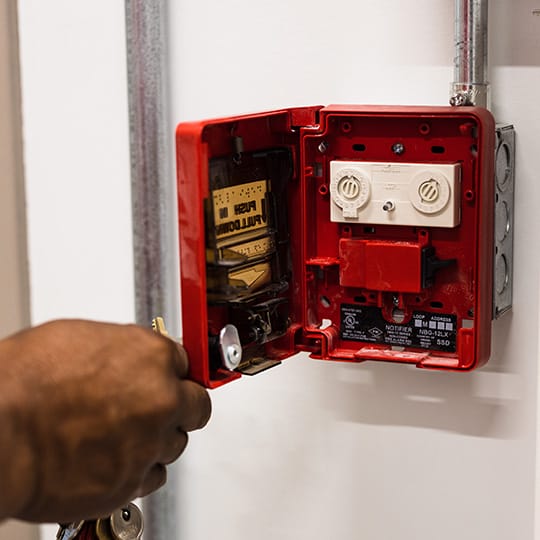
The same team that designed the system installs it, using in-house, NICET-certified technicians rather than subcontracted labor. Before sign-off, every device and every integration point goes through pre-functional checks and functional performance testing, proof that the fire alarm actually unlocks the right door and notifies the right people, not just that it powers on.
Inspection & Maintenance
How often does a commercial system need inspection?
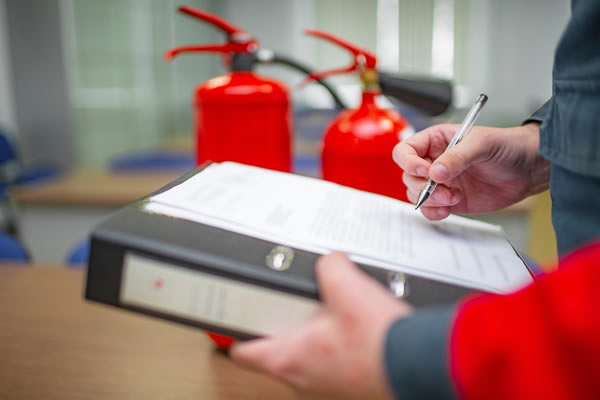
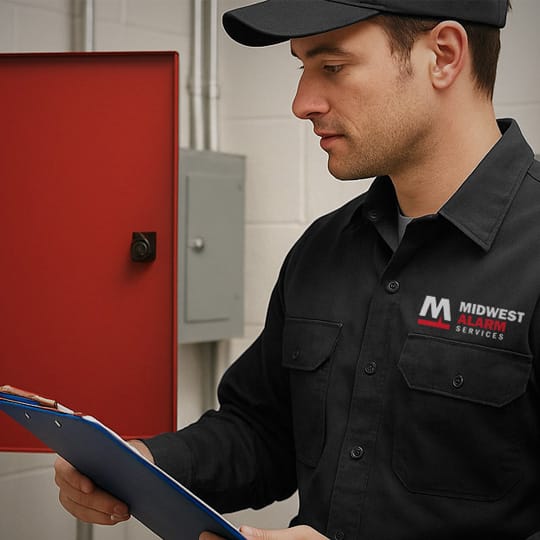
Inspection intervals depend on the system, component, and adopted NFPA and local code requirements, and MWAS schedules and tracks them so the facility doesn’t have to, whether MWAS installed the system or not. Testing covers every low-voltage system on-site, not fire alarm alone, with every report centralized in a digital record ready for an AHJ or insurer on request.

24/7 Professional Monitoring Services
Does MWAS monitor systems it didn’t install?
The fourth phase never turns off. MWAS’s monitoring center supervises fire, intrusion, and emergency communication lines around the clock, confirming they’re active and dispatching immediately to the fire department or law enforcement when an alarm is verified. MWAS monitors systems it designed and installed, and can take over monitoring for systems installed by other companies after a quick review to confirm the system is functioning and current.
Why One Partner for the Whole Lifecycle
Managing four vendors means four contracts, four sets of records, and four different people to call when something doesn’t line up. It also means no one is fully accountable when a system fails an inspection: the designer points to the installer, the installer points to whoever’s been maintaining it since.
MWAS has run this model for 75 years. A coordinated network of regional branch hubs across Nebraska, Iowa, Kansas, Wisconsin, and Michigan, backed by over 100 NICET-certified technicians, works across all four phases, so the same company that designed the system is the one standing behind it on inspection day and answering the monitoring line at 2 a.m.